
If you have been getting estimates for a wet basement, you have probably heard both options come up. Interior waterproofing. Exterior waterproofing. They sound like opposites, and in some ways they are. But the real question is not which one sounds better. It is which one actually solves your specific problem. Here is a plain-language breakdown to help you make sense of it.
What Interior Waterproofing Does
Interior waterproofing does not stop water from entering the wall. What it does is intercept water that has already made it inside and channel it away before it can damage your floor, framing, or belongings.
The most common interior solution is drain tile, also called a perimeter drainage system. A channel is cut along the inside base of the foundation walls, a perforated pipe is laid in gravel, and the floor is restored over it. Water that seeps through the wall or up through the floor-wall joint flows into the pipe and gets directed to a sump pit, where a pump sends it out of the house.
Interior waterproofing is less invasive than exterior work, generally more affordable, and in many cases it is the right answer for ongoing basement seepage.
What Exterior Waterproofing Does
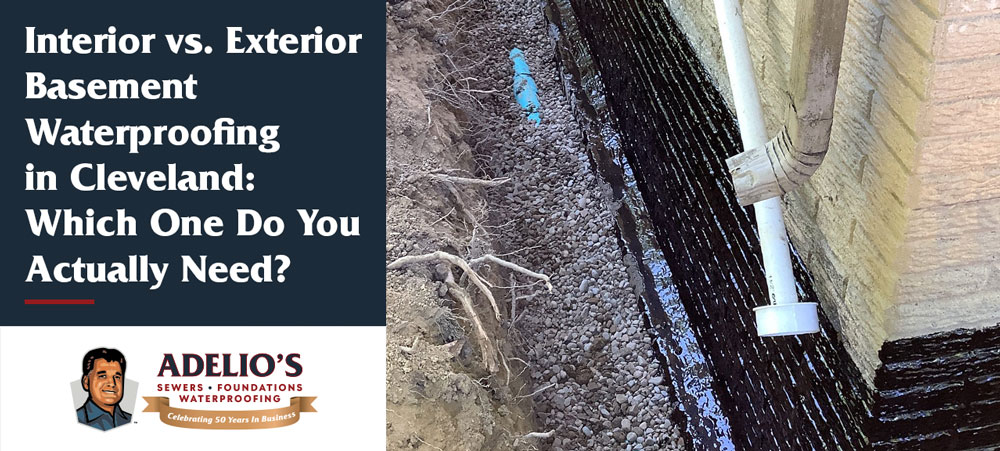
Exterior waterproofing addresses the problem from outside the foundation. It involves excavating down around the perimeter of the home, cleaning and repairing the foundation wall, applying a waterproof membrane, and installing drainage at the footing to carry water away before it ever contacts the wall.
This is the more thorough approach and the only one that actually stops water from reaching the foundation. It is also significantly more involved in terms of labor, time, and cost, especially on developed properties where access to the exterior is limited.
So Which One Do You Need?
The answer comes down to what is causing your water problem and where it is entering. A few scenarios that point toward each option:
- Water seeping through the wall or at the floor-wall joint during heavy rain is often handled well by interior drain tile, since the goal is to manage the water that gets through rather than stop it at the source.
- Active cracks in the foundation wall where water is visibly pushing through are better addressed from the outside, where the crack can be sealed and a waterproof membrane applied directly to the wall surface.
- A failed or missing exterior waterproof coating is an exterior problem that typically calls for an exterior solution.
- Tight lots, mature landscaping, driveways, or fences that make excavation impractical often make interior drain tile the more realistic choice even when exterior work would theoretically be ideal.
- Homes that have already had interior drain tile installed but are still experiencing issues sometimes need exterior work to fully resolve the problem.
Can You Do Both?
Yes, and in some cases that is exactly the right answer. A home with active foundation cracks and ongoing seepage might benefit from exterior crack repair combined with interior drain tile to manage any residual moisture. The two approaches are not mutually exclusive.
What matters most is getting an accurate diagnosis of where the water is coming from before committing to either option. A contractor who recommends one or the other without thoroughly inspecting your specific situation is guessing, and that rarely ends well.
Get a Straight Answer from Someone Who Knows Cleveland Basements
Adelio’s Contracting has been diagnosing and waterproofing basements across Northeast Ohio for over 50 years. We work with homeowners in Cleveland, Lakewood, Shaker Heights, Beachwood, Rocky River, Mayfield Heights, and communities throughout the region. We will look at your basement, explain what we find, and tell you what will actually fix it.
Call (440) 943-2233 or book online to schedule your free evaluation.