
If you’ve dealt with a wet basement in Cleveland, you’ve probably heard conflicting advice from contractors. Some insist exterior waterproofing is the only “real” fix. Others say interior systems are a smarter, more practical solution. And if you’ve ever tried to sort through the competing claims online, you know how quickly the research spiral starts.
Here’s the honest answer: both interior and exterior basement waterproofing can work — but not in every situation, and not for every home. In Northeast Ohio, where clay-heavy soil, harsh winters, and aging housing stock create a perfect storm for basement water problems, choosing the right method depends on understanding what’s actually causing the issue in the first place.
At Adelio’s Contracting, we’ve been helping homeowners across Cleveland, Lakewood, Shaker Heights, Strongsville, and the surrounding communities stay dry since 1976. What we’ve learned in the last 50 years is simple: the solution has to match the problem. Here’s a clear breakdown of how each method works — and when each one makes sense.
Why Basements Flood in Cleveland-Area Homes
Basement water problems are widespread throughout Northeast Ohio, and the region’s conditions make them almost inevitable in older homes. Heavy rainfall, Lake Erie snowmelt, and freeze-thaw cycles put relentless pressure on foundations. The clay-dense soils common from Cleveland Heights to Solon absorb water, expand, and contract with each season — slowly forcing moisture into every available gap.
The most common causes of basement water intrusion we see include:
- Cracks in foundation walls — both poured concrete and block — that open further with seasonal movement
- Hydrostatic pressure building beneath the basement slab during heavy rain or snowmelt
- Leaking window wells that funnel water directly into the foundation
- Poor exterior drainage or grading that directs water toward the house rather than away
- Failing or clogged drain tile systems — a common finding in homes built before the 1980s
Because water can enter from multiple directions and for multiple reasons, no single waterproofing method works for every home. That’s where understanding the difference between interior and exterior systems becomes essential.
How Interior Basement Waterproofing Works
Interior basement waterproofing doesn’t stop water from entering the foundation — it manages water after it arrives. These systems are engineered to relieve hydrostatic pressure and redirect moisture safely out of your basement before it causes damage.
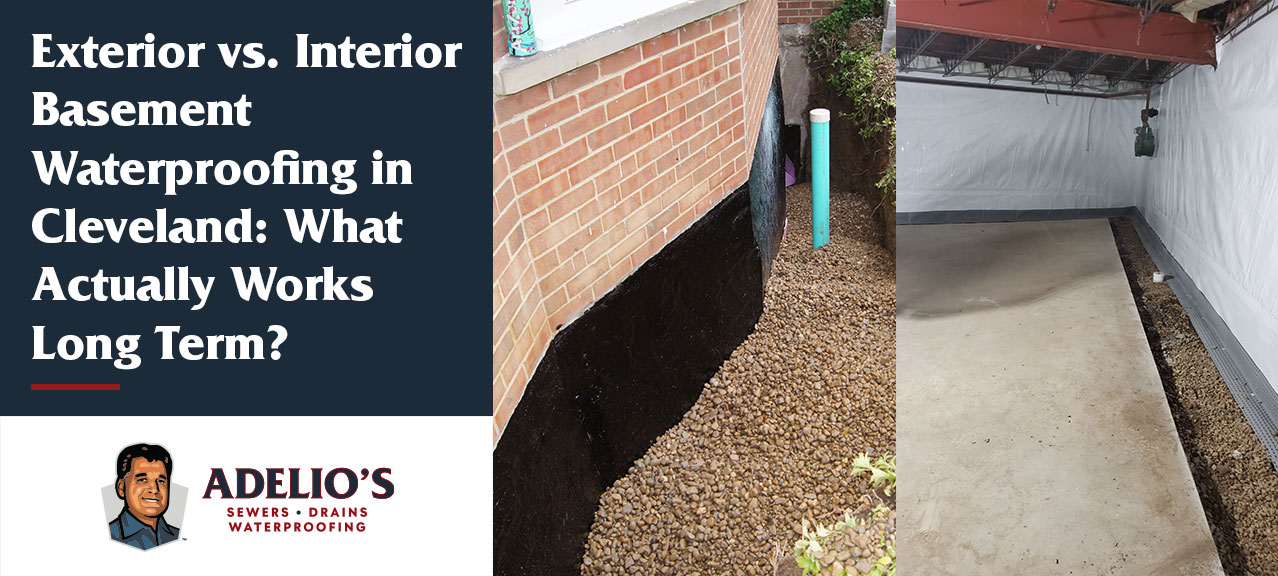
A properly installed interior system typically includes a perimeter drainage channel installed along the inside of the foundation footing, a sump basin and sump pump to collect and discharge water, and, in some cases, wall vapor barriers to manage seepage coming through porous block or concrete. When groundwater builds up around the foundation, the system intercepts it before it reaches your basement floor.
Interior waterproofing can be the right choice when:
- Seepage is coming up through the basement floor slab
- Exterior excavation isn’t practical because of patios, driveways, landscaping, like mature trees, or tight property lines
- The foundation walls are structurally sound and the primary problem is minor
Interior systems can be the right solution for your home when if you’re looking for a solution that can be installed year round or a solution that helps you avoid the removal of certain exterior items, like trees or patios, etc.
How Exterior Basement Waterproofing Works
Exterior waterproofing goes to the source by addressing moisture before it ever reaches your foundation walls. This approach involves excavating the soil around the perimeter of your foundation, repairing any cracks or structural damage in the walls, applying waterproof membrane to the exterior surface, replacing the exterior drain tile system, ensuring the drain tile connects to a flowing storm sewer, and backfilling the excavated trench with gravel to allow for the water to flow unobstructed to the drain tile.
Exterior waterproofing can be the right choice when:
- Water is actively entering through wall cracks or porous masonry block at any point, including the floor joint
- You are looking for a long-term low maintenance solution that prevents the water from intruding
- Long-term structural protection of the foundation walls themselves is the priority
- Water is entering through the cove joint — where the wall meets the floor — due to hydrostatic pressure
- A Finished or Dry Basement is the priority
- The issue is localized, exterior waterproofing can be customized to address a single wall or corner
When done correctly, exterior waterproofing provides excellent protection by keeping the foundation walls dry and stable from the outside. It is a solution that is customizable to address the current issue and solve for what the active issue is. Exterior waterproofing requires minimal maintenance and has not pumps or parts that may require replacement over the years.
Which One Actually Lasts Longer?
This is the question homeowners ask most often — and the truthful answer is that longevity depends less on which method you choose and more on whether the solution was matched to the right problem.
A properly installed interior drainage system can perform effectively for decades with minimal maintenance. Paired with a reliable sump pump and a battery backup, these systems handle the groundwater that causes the vast majority of basement water intrusion we see across Northeast Ohio.
Exterior waterproofing also lasts decades when properly executed — When installed with replacement drainage and ensuring that existing storm sewer systems are properly working, the system will work in tandem to collect and remove the water from your basement foundation, the replacement of the clay soil directly along you foundation wall with gravel will alleviate hydrostatic pressure and future foundation shifting or cracking.
Why One-Size-Fits-All Waterproofing Doesn’t Work in Northeast Ohio
Cleveland-area homes vary enormously. A 1920s brick home in Lakewood has a fundamentally different foundation than a 1970s poured-concrete ranch in Strongsville or a century-old stone basement in Cleveland Heights. Soil conditions, lot drainage, proximity to Lake Erie, and the original construction quality all play a role in how water enters and how it should be managed.
This is why high-pressure sales tactics that push one method over all others are a red flag. A contractor who recommends the same solution for every home — without evaluating where and how water is getting in — isn’t solving your problem. They’re selling you a product.
The right waterproofing plan starts with an honest inspection: understanding the entry points, the soil conditions, the structural condition of the foundation, and what the homeowner’s long-term goals are. Only then does recommending a system make sense.
Get an Honest Answer — Not a Sales Pitch
At Adelios Contracting, we’ve been serving homeowners across the Cleveland metro — from Beachwood and Mayfield Heights to Rocky River, Solon, and Fairview Park — since 1976. In the last 50 years, we’ve seen every kind of basement water problem Northeast Ohio can produce, and we’ve learned that honest diagnosis always leads to better long-term outcomes than pushing the most expensive fix.
Sometimes the answer is a full interior drainage system. Sometimes it’s targeted exterior waterproofing. Sometimes it’s as simple as improving your grading or cleaning your gutters. We’ll tell you what your home actually needs — and exactly why.
If you’re dealing with a wet basement, recurring moisture, or foundation cracks anywhere in the Cleveland area, now is the time to get a professional opinion. We offer thorough, no-pressure basement waterproofing evaluations throughout Northeast Ohio.
Call Adelio’s at (216) 250-3074 or contact us online to schedule your evaluation. We’ll help you understand what’s causing the problem — and what will actually work long-term.