
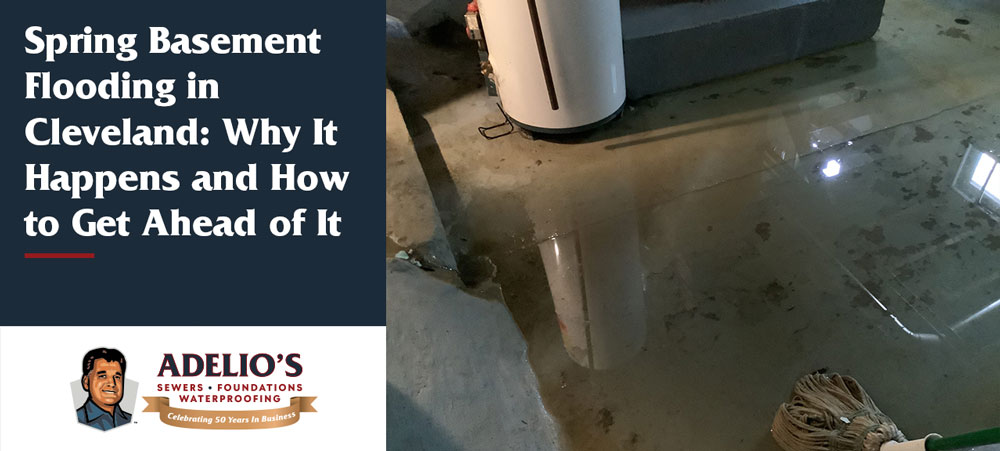
For a lot of Cleveland-area homeowners, spring is the season when basement flooding problems become impossible to ignore. The snow melts, the rain arrives, and suddenly there is water where there should not be. It happens every year, and yet it still catches people off guard. Understanding why spring flooding happens in Northeast Ohio is the first step toward doing something about it before the water shows up.
Why Spring Is the Hardest Season for Cleveland Basements
Northeast Ohio winters leave a lot of moisture behind. Months of snow and ice accumulate, and when temperatures rise in March and April, all of that water releases into the ground at once. At the same time, spring rainstorms arrive and add even more water to soil that is already completely saturated.
The clay-heavy soil throughout Cuyahoga, Lake, Lorain, and Geauga counties makes this worse. Clay does not drain well under any circumstances. When it is already full of snowmelt and then gets rained on repeatedly, there is simply nowhere for the water to go except sideways, and that often means right up against your foundation.
What Is Actually Causing the Water to Come In
Spring flooding does not have one single cause. It usually comes from a combination of things happening at the same time:
- Hydrostatic pressure builds up when saturated soil presses against the outside of your foundation walls. Any crack, gap, or weak joint becomes a potential entry point when that pressure gets high enough.
- The floor-wall joint is one of the most common places water enters during spring. This is the seam where the basement floor meets the foundation wall, and it is rarely perfectly sealed in older homes.
- Window wells that have not been cleaned out over the winter fill up quickly during spring rain and can overflow directly into the basement through the window frame.
- Gutters and downspouts clogged with winter debris send water cascading down the side of the house and pooling right next to the foundation instead of being directed away from it.
- Sump pumps that have not been tested or maintained can fail at exactly the wrong moment, leaving water with nowhere to go.
What You Can Do Before the Next Spring
The good news is that most spring flooding is preventable with the right preparation. A few things worth doing while the weather is still on your side:
- Test your sump pump by pouring water into the pit and confirming it activates and discharges properly. If it has not been serviced in a few years, now is a good time.
- Clean out your gutters and make sure downspout extensions are directing water at least four to six feet away from the foundation.
- Clear any debris from window wells and check that they have functioning drains at the bottom.
- Walk the perimeter of your home after a heavy rain and look for areas where water is pooling close to the house. Low spots and negative grading are easy to identify when you know what you are looking for.
- Have a waterproofing professional take a look at your basement if you had any water intrusion last spring. Catching small problems before the season hits costs far less than dealing with the aftermath.
When Preparation Is Not Enough
Sometimes the underlying issue is bigger than maintenance alone can address. If your basement has flooded more than once, if you are seeing water stains or efflorescence on the walls, or if your sump pump runs constantly during wet weather, those are signs that your drainage system needs a closer look.
Interior drain tile, foundation crack repair, and exterior drainage solutions are all options that can make a permanent difference for homes that flood seasonally. The right approach depends on where and how water is getting in.
Adelio’s Is Ready Before Spring Hits
Adelio’s Contracting has been helping Cleveland-area homeowners get ahead of spring flooding for over 50 years. We serve communities throughout Northeast Ohio including Cleveland, Euclid, Willoughby, Mentor, Solon, Strongsville, and beyond. If last spring was a problem at your house, let us take a look before the next one arrives.
Call (440) 943-2233 or book online to schedule your free evaluation.